Jun 29, 2026

Losing Medicaid coverage is often not a clinical or eligibility problem. It is an operational one. The One Big Beautiful Bill Act (OBBBA) / H. R. 1 dramatically raises the stakes.
Much of the public discussion has focused on funding reductions and work requirements. While those issues are important, they obscure a much larger transformation underway. OBBBA changes Medicaid from a program centered on eligibility determination into one increasingly centered on ongoing eligibility verification and compliance management.
Beginning in 2027, millions of Medicaid beneficiaries will be subject to recurring work and community engagement verification requirements, more frequent eligibility reviews, expanded documentation obligations, and increasingly complex reporting processes. The Congressional Budget Office estimates that millions of Americans will lose coverage under the new framework. Not because they are ineligible, but because they are unable to successfully navigate the administrative burden required to maintain it.
The biggest threat to Medicaid coverage in 2027 is not unemployment, but paperwork.
The Real Challenge Isn't Work Requirements. It's Administrative Burden
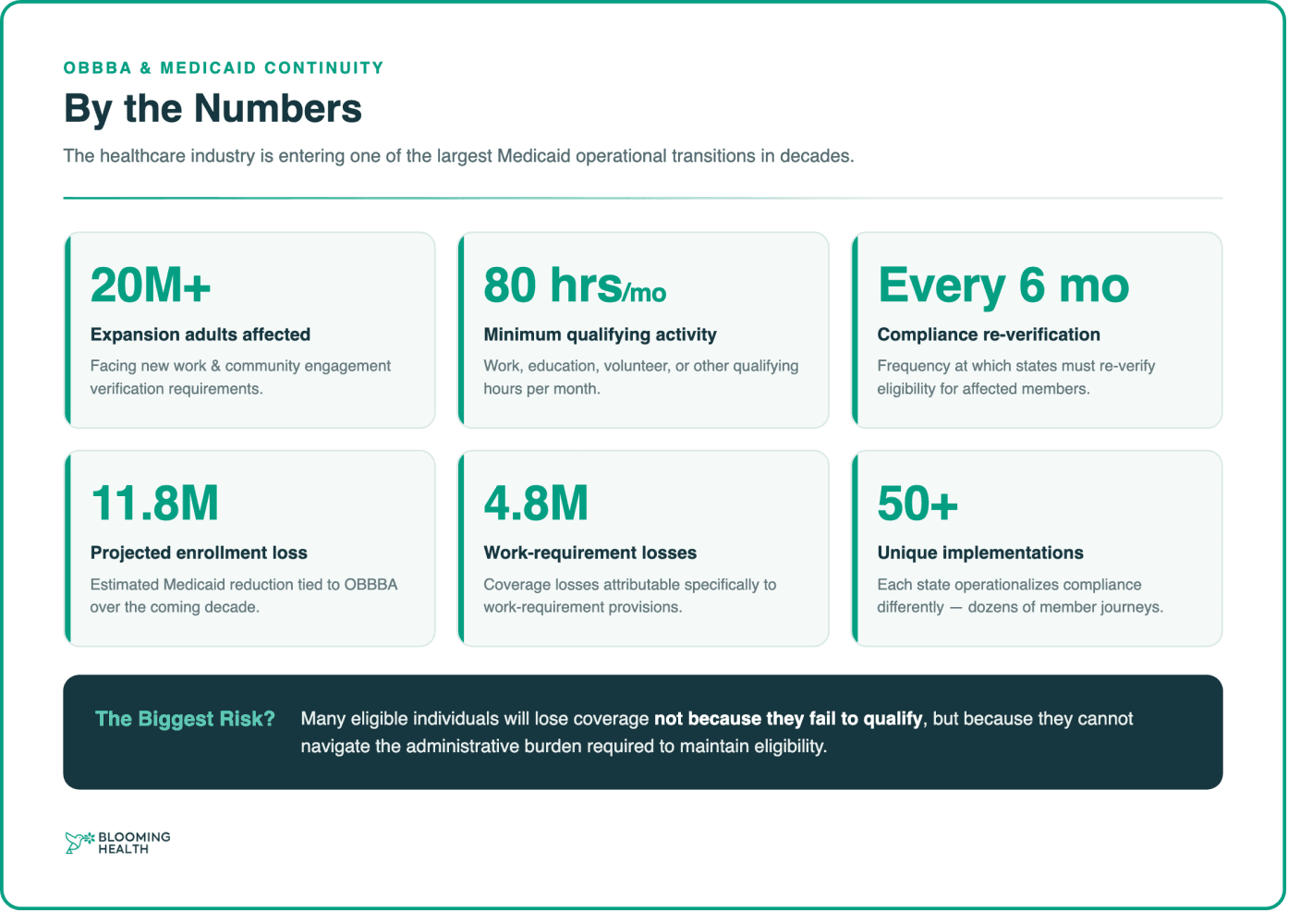
The unwinding of continuous enrollment protections following the COVID-19 public health emergency forced health plans, health systems, community organizations, and state agencies to mobilize at unprecedented scale to help millions of Americans maintain coverage. The lessons from unwinding were profound: More than 20 million Americans lost Medicaid coverage during the process (source: KFF.org). While some no longer qualified, many remained eligible but lost coverage because they missed notices, failed to submit documentation, struggled with administrative processes, or simply could not navigate increasingly complex eligibility requirements. The healthcare industry learned a difficult lesson: losing Medicaid coverage is often not a clinical problem. It is an operational one.
There is no such thing as a national Medicaid recertification strategy. Medicaid may be federally funded, but it is operationally administered through a patchwork of state and local systems that vary dramatically in structure, technology, reporting requirements, exemption pathways, and member experience. Organizations preparing for OBBBA must recognize that scaling Medicaid continuity requires navigating dozens of state-specific operational systems simultaneously.
In New York, eligibility administration spans state exchanges, county systems, and local social service agencies. In California, county-level administration creates 58 distinct operational environments. In Ohio, county Job and Family Services agencies play a central role in eligibility determination and verification. New Jersey operates through a hybrid state-county structure with its own unique workflows and requirements. These differences matter.
Experience from previous work requirement implementations and the Medicaid unwinding process suggests that administrative complexity—not eligibility itself—is often the primary driver of coverage loss. Individuals may qualify for exemptions but fail to document them. Individuals may be working but struggle to report qualifying activities. Individuals may receive notices they do not understand. Individuals may miss deadlines because communications arrive in the wrong language, through the wrong channel, or at the wrong time.
Many beneficiaries work multiple jobs, care for children or aging family members, face transportation barriers, or have limited access to technology. Asking these populations to repeatedly navigate complex eligibility systems every six months creates significant operational risk for states, providers, and health plans alike.
This is why healthcare organizations increasingly view Medicaid continuity not as an enrollment problem, but as an engagement, documentation, and workflow problem.
The Emergence of Medicaid Continuity Infrastructure
A new category is emerging in healthcare: Medicaid Continuity Infrastructure. Its purpose is to ensure that eligible individuals remain continuously enrolled despite increasing administrative complexity. The key difference for this category: it cannot be a standalone solution - it needs to be integrated into the community. Healthcare leaders often speak about access to care as if it begins at the clinic door. Increasingly, access to care begins much earlier. It begins with maintaining coverage.
For Medicaid continuity, that means identifying members at risk of losing coverage, educating them on state-specific requirements through trusted channels, collecting documentation, helping complete forms, navigating exemptions, coordinating and making referrals for workforce and community resources when needed to meet work requirements, submitting applications, verifying completion, and maintaining engagement over time. A complex and long process prone to people falling through the cracks. This generation of healthcare infrastructure will not be defined by who can send the most reminders or fill out the forms. It will be defined by who can stay with and guide individuals through complex administrative processes, remove barriers before they lead to coverage loss, and ensure people receive the support they need to stay connected to care at the most critical moments.
A Defining Moment for Healthcare
The policy changes introduced through OBBBA will challenge every part of the healthcare ecosystem. States must redesign eligibility operations. Health plans must prevent avoidable member attrition. Health systems must protect continuity of care. Community organizations must support increasingly complex member needs. The organizations that succeed in this environment will be those that treat Medicaid continuity as a strategic capability embedded into people’s journey in their community, rather than an administrative function for “patients”.
In addition, work requirements demand a different response than paperwork. When someone is short of the 80-hour threshold, you cannot message your way to compliance. The system has to understand their skills, availability, and barriers, then connect them to real work, training, or volunteer opportunities.
In fact, healthcare organizations have an opportunity—and arguably a responsibility—to help vulnerable individuals remain connected to both healthcare and economic opportunity. Many Medicaid beneficiaries facing work requirement challenges are also managing chronic conditions, caregiving responsibilities, transportation barriers, or other social determinants that make workforce participation more difficult.
Successfully addressing these requirements will require more than monitoring compliance. It will require identifying individuals at risk of losing coverage, understanding their skills, interests, location, availability, and support needs, matching them with appropriate employment, training, volunteer, or community engagement opportunities, and helping them successfully navigate the path to compliance. In this sense, Medicaid continuity becomes not only a healthcare challenge, but also a workforce engagement challenge—one that demands coordinated action across healthcare organizations, community partners, workforce development agencies, and technology platforms.
At Blooming Health, we recognized this shift early. We designed our Care Enablement Workflows not as an outreach tool, but as the foundational infrastructure required to scale this community-centered approach. An AI-powered co-pilot that supports navigators by guiding Medicaid applicants through community-centered workflows designed to keep people enrolled in benefits.
Unlike traditional outreach campaigns or modern apps on devices, Care Enablement Workflows create ongoing two-way engagement. Through SMS, voice, email, and other communication channels, AI agents can proactively identify beneficiaries who may be at risk of losing coverage, guide them through renewal requirements, answer common questions, collect information, and escalate complex situations when human support is needed.
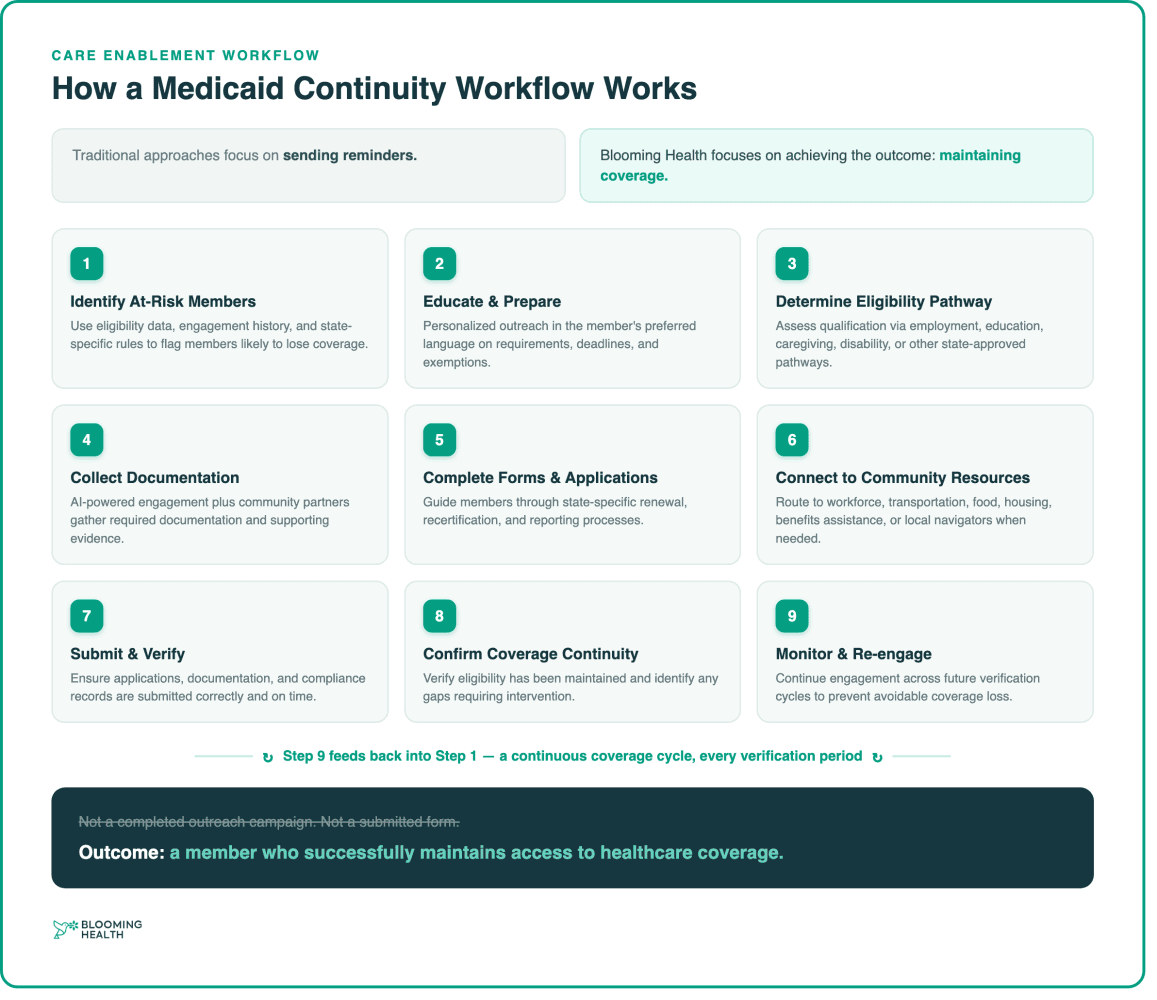
These workflows operate continuously, meeting people where they are. A Medicaid beneficiary working two jobs may not be available to respond during business hours. The Medicaid Care Enablement Workflow allows them to engage at the time and through the channel that works best for them, and in over 50 languages, creating a personalized, accessible, and responsive experience. Powered by our predictive analytics layer, Blooming learns from more than 2 million member engagements every month. This gives us one of the largest engagement datasets in social care, enabling us to continuously train and refine our engagement optimization models to maximize personalization, member responsiveness, and overall engagement yield.
Most importantly, the workflows do not stop at identifying a need. They are designed to help resolve it. If a beneficiary is missing documentation, confused by eligibility requirements, struggling with transportation, facing language barriers, or needs assistance completing next steps, the workflow can provide guidance, connect them to trusted community organizations or book an appointment for them, or route them to a care manager or navigator for additional support.
This combination of member journeys tailored to each individual’s preferences, integration into the broader care journeys e.g. in addressing the member’s health related social needs, and trusted community engagement is what makes the model effective. Technology provides the scale necessary to support millions of beneficiaries. Community-based organizations, healthcare providers, care managers, faith-based organizations, and other local partners provide the trust and human support required when challenges become more complex.
The result is a financially and operationally scalable approach to Medicaid continuity. Rather than relying exclusively on labor-intensive outreach and manual case management, organizations can automate routine workflows while enabling staff and trusted community partners to focus on individuals who require deeper, high-touch support. We estimate this community-enabled, AI-powered model can operate at approximately one-tenth the cost of traditional Certified Application Counselor (CAC)-driven approaches while reaching significantly larger populations.
More importantly, the greatest value is not the reduction in administrative costs; it is preventing eligible individuals from losing healthcare coverage because they are unable to navigate increasingly fragmented and complex recertification processes. Every successful renewal preserves access to primary care, medications, behavioral health services, and other essential healthcare benefits while reducing avoidable disruptions for health plans, providers, and patients alike.
Unlike point solutions that focus solely on eligibility renewal, Blooming's Medicaid Recertification Care Enablement Workflow is fully integrated into our broader care enablement platform. As we help members maintain coverage, we simultaneously identify and address other barriers to care, including transportation, food insecurity, housing, and other social needs. For example, if a member has an upcoming primary care appointment, our platform works to ensure that neither a lapse in Medicaid coverage nor a lack of transportation prevents them from receiving care. By addressing these interconnected barriers through a single workflow, organizations improve not only coverage continuity but also care gap closure, quality outcomes, and overall population health.
Blooming Health supports Health Systems, FQHCs, Health Plans, Community Care Hubs/Social Care Networks, government agencies, and Community-Based Organizations reaching over 6.5 million individuals across 25 states through a network of over 2,000 organizations demonstrates the scalability of this approach.
The upcoming coverage crisis will test the limits of our entire healthcare ecosystem. For health plans, health systems, and community networks, building this infrastructure cannot wait - the time to act is now. Let’s work together to ensure that administrative burden never stands between a vulnerable individual and the care they deserve.
Join us in making care and benefits truly accessible to all.